VIR · INVICTVS
Ex libris Brandon LaRocque
❦ programmer · curator · former chef ❦
I. On the Author
My work is native Linux desktop software. Rust with GTK4, C built with Meson, Python where the standard library reaches. Local-first by default. SQLite on the user’s disk in WAL mode, single-writer worker, read-only connection pool, FTS5 for search. No cloud accounts. No Docker. No Electron. No telemetry.
I prefer compile-time boundaries to code-review rules, and hard memory ceilings to optional benchmarks. I will port a battle-tested architecture with attribution before I invent a new one.
I came to the work late. Ten years in restaurants and mining camps before The C Programming Language. I read it at night, between shifts, because the cover looked serious and I wanted to know what serious looked like. A Computer Engineering Technician student now, with a CS bachelor’s underway at Algoma. The credential follows the practice.
By temperament I am an archivist. I keep a private Calibre library that runs into the four figures, a music collection sorted by hand, an RSS spool I read every morning. Friends have called the practice shadow librarianship. The catalogue is my own, kept on my own disks, indexed by my own tools. Most of what I build is for the kind of person who treats their library as worth maintaining.
The site is named Vir Invictus, the unconquered. It is a working motto, not a brand.
❦
II. The Collection
Sixteen projects. Native Linux desktop software at the centre, with game-design work and an Emacs theme at the edges. Local-first by default; the throughline is curation. Atrium is the largest piece and the one in motion; the rest sort by current state.
Atrium
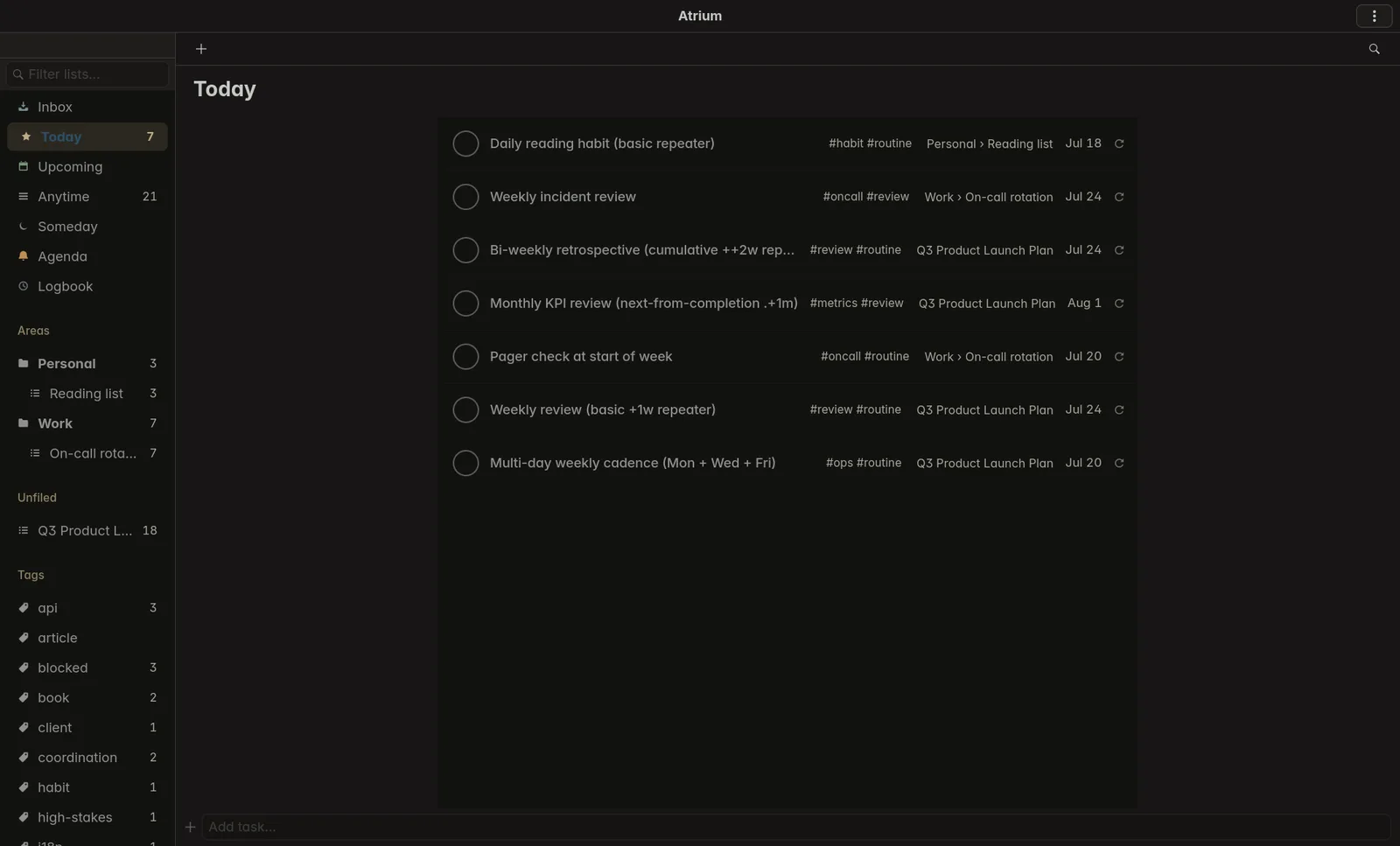
The native GNOME task manager you grow into, not out of. An Org-mode app wearing a Things 3 / OmniFocus disguise: UUIDs on every node, plain-text round-trip, deadlines and schedules and contexts as first-class data, in a fast GTK4 surface that never asks you to open Emacs. Simple Mode for what am I doing right now (six canonical lists, no defer dates, Things 3 calm); Builder Mode for the days the system has to do the work (Forecast, Agenda, Kanban, Calendar, Review with per-area cadences that cascade to the projects filed under an area, Perspectives, repeating and sequential projects, blocked-by task dependencies, time-based system reminders, a live Inspector). Same data, two surfaces, no migration: flipping modes is a UI re-render over an OmniFocus-superset schema that was there on day one.
Local-first SQLite in WAL mode, single-writer worker, read-only connection pool. FTS5 search through a hand-written Calibre-style expression grammar (tag:work AND is:overdue sort:-due, due:2026-05-01..2026-05-31, tag:?wrok for fuzzy match). A six-crate workspace; the extracted atrium-inline engine (#tag, @today, !priority with tab-completion) and the atrium-org round-trip layer are both tested headlessly, away from the UI. more than a thousand tests and 18 migrations, with a 1K-fixture smoke and cold-start check gating every push. Org is the two-way mirror, and importers bring the rest across: Todoist CSV, Taskwarrior task export JSON, todo.txt, and iCalendar VTODO (import and export). A Flatpak manifest ships alongside the native build.
Viaduct
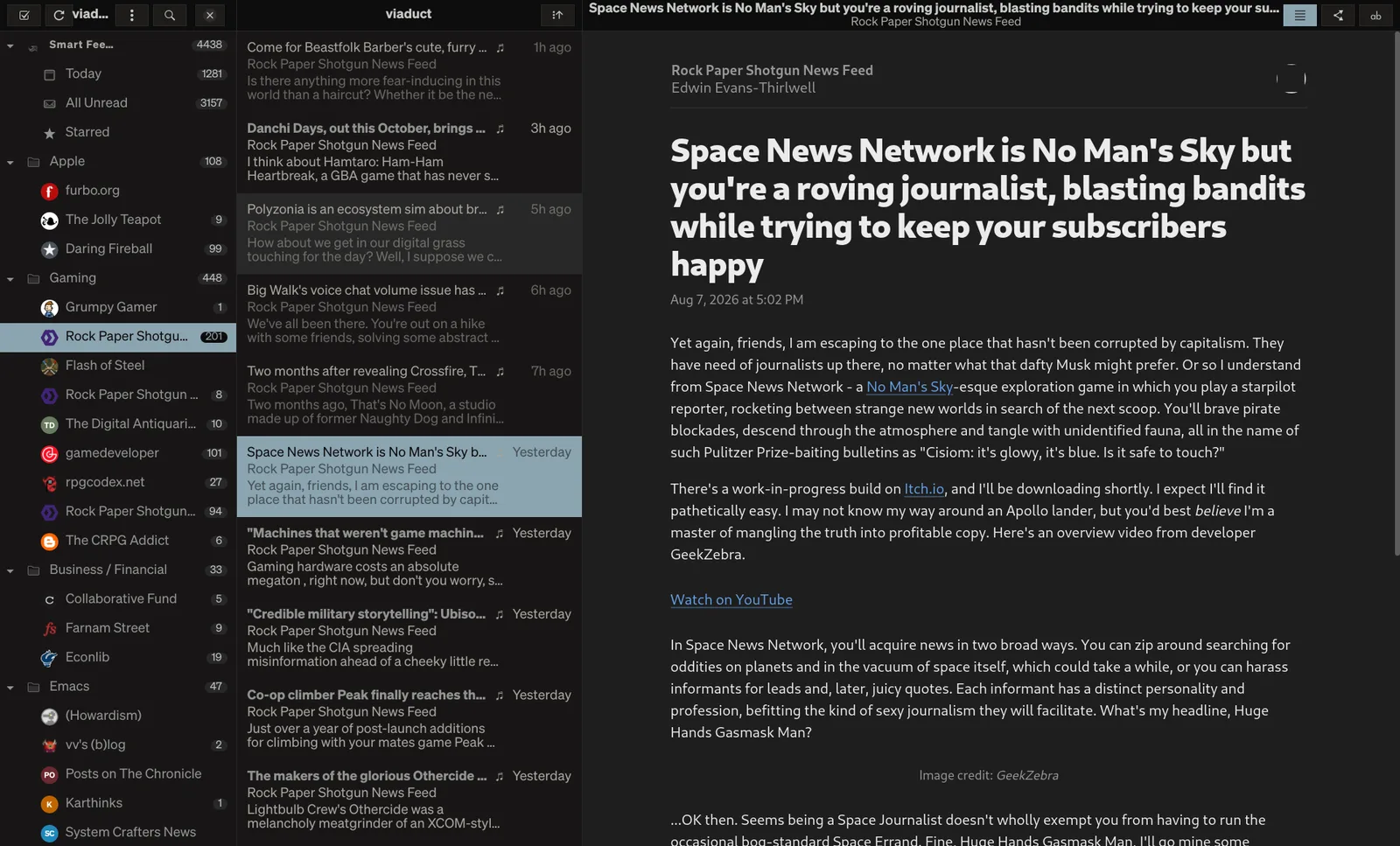
A Linux port of Brent Simmons’ NetNewsWire RSS reader. A Cargo workspace split between a headless viaduct-core (database, network, parser, models) and a viaduct GTK binary, making the architectural boundary a compile error rather than a code-review rule. Idles at 100–300 MB against ~600 MB for the closest Linux competitor on the same OPML, with a hard 500 MB ceiling enforced by an in-tree mem_check harness.
Single-writer SQLite worker on tokio across three WAL databases (articles, feed settings, sync). OPML on disk as the source of truth, byte-for-byte compatible with NetNewsWire; NetNewsWire-faithful parsing of RSS 2.0, RDF, Atom, JSON Feed, and RSS-in-JSON. Local and Inoreader accounts, the latter a port of NetNewsWire’s ReaderAPI sync engine. The article pane is exactly one neutered WebKit instance: JS, WebGL, WebRTC, DevTools, and LocalStorage off, strict CSP, every image routed through a custom viaduct-img:// scheme so the WebView never reaches the open internet.
The v2.x line built an original surface on top of the port: Custom Smart Feeds (rule-driven saved searches), an Activity Log over a ring buffer, a Send-to menu, Reader View, OPML import/export, and adaptive AdwBreakpoint layout that collapses the three-pane split into mobile stacks. All eight NetNewsWire themes plus an Adwaita variant, with the theme accent propagating across the GTK chrome. A background-daemon mode runs Viaduct as an XDG autostart agent and re-summons the window over D-Bus. A Flatpak manifest ships alongside the native build.
Hermitage
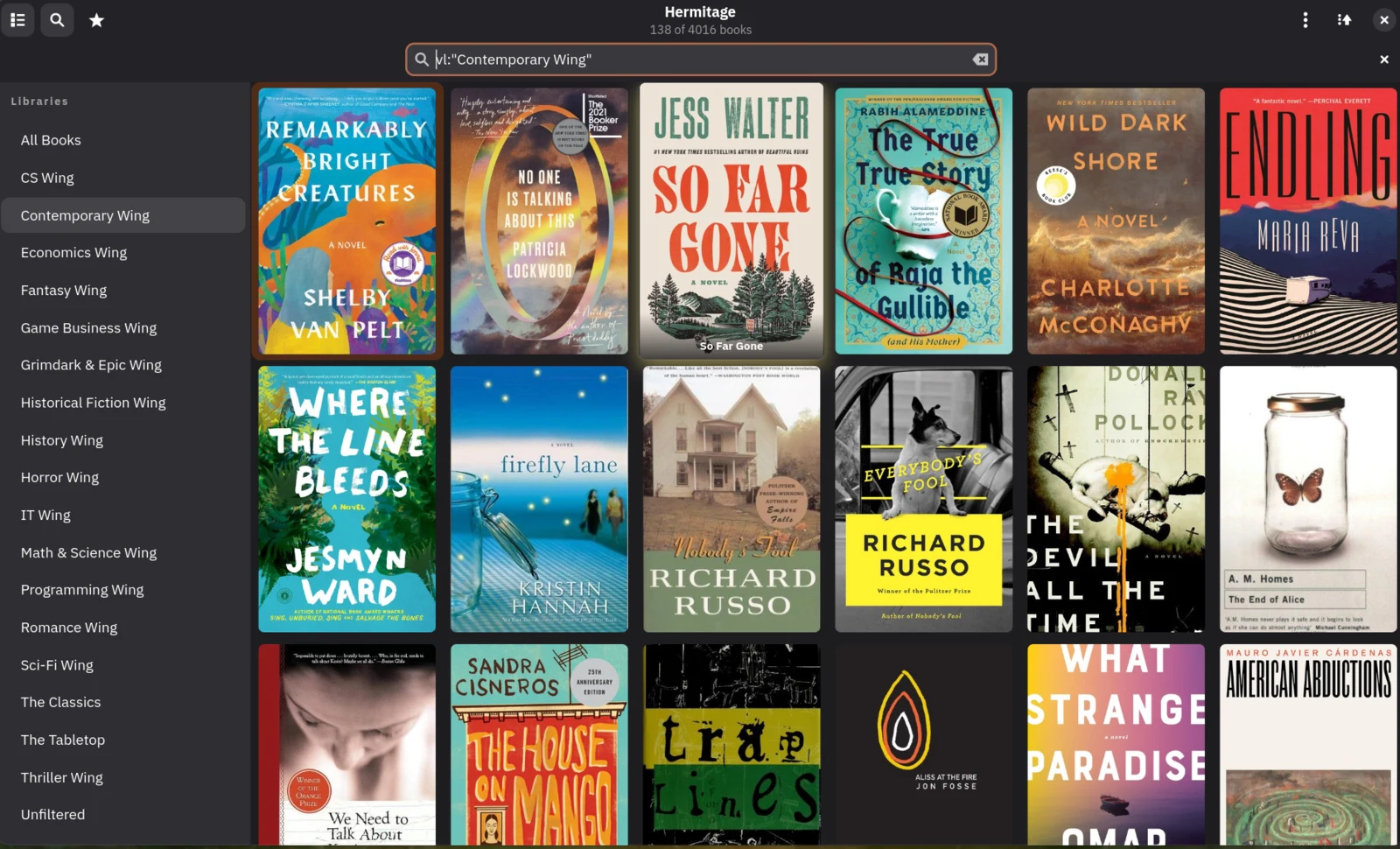
A local-first, native gallery for Calibre libraries, for the single user who wants a modern desktop experience without Docker or a web auth layer. Reads metadata.db in mode=ro and turns a 4,000+ item library into a cinematic gallery: an edge-to-edge cover grid with median-cut colour quantization for per-book accent tinting, a sliding hero-banner detail sidebar (the Codex), and a recursive genre browser that unfolds dot-separated Calibre tags (Fic.Fantasy.Grimdark) into a navigable tree.
Native support for Virtual Libraries and the full Calibre search-query language (Ctrl+F), with a 512-entry texture LRU and three-tier colour cache to keep scrolling smooth on integrated graphics. Ships hermitage-verify, a standalone CLI that audits integrity, cover presence, and format resolution. Zero telemetry, zero network calls, zero accounts. A GNOME 50 Flatpak ships alongside the native build: 8 MB, sandboxed, with arbitrary library paths reached through the file-chooser portal.
Lattice
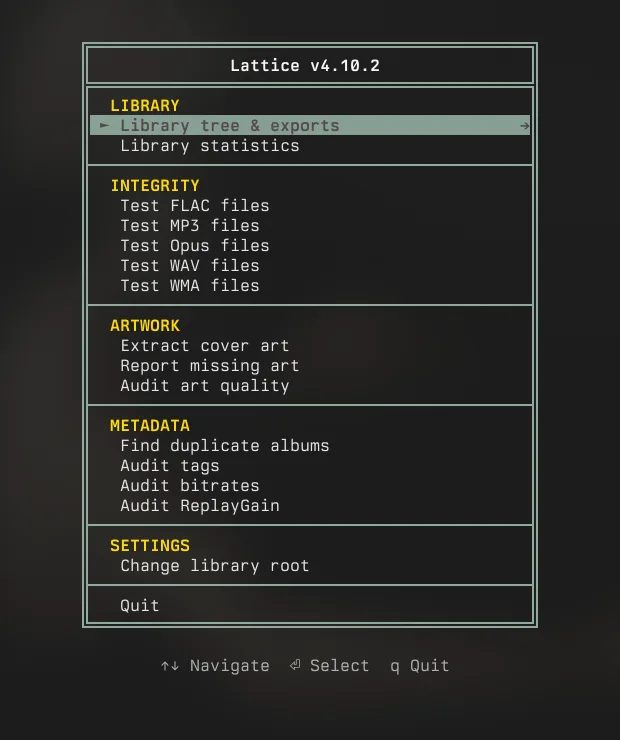
A toolkit for music collectors who keep the filesystem as the source of truth. Library-tree visualization across artist / album / track / rating / genre. Parallel FLAC / MP3 / Opus / WAV / WMA integrity verification (shelling out to flac -t and ffmpeg), embedded cover-art extraction with format-priority ranking, an art-quality audit against a configurable resolution floor, and tag, bitrate, and duplicate audits. Smart .m3u generation from dynamic rules (rating >= 4 and genre == 'Jazz'), per-genre wings (one library file per genre, like Calibre virtual libraries for music), and a token-efficient --ai-library export sized to fit a 4,000-album collection inside an LLM context window. The directory layout is configurable, so the tools never fight you about your shelving. Bare lattice opens a full-screen curses TUI.
The package is read-only by design: it reads tags, decodes audio, writes reports. Two destructive companions live at the repo root, deliberately outside the package boundary so the read-only contract holds. retag.py is the universal genre rewriter, abstracting the ID3 / Vorbis / iTunes-atom multi-genre chaos for safe bulk retagging. cleaner.py consolidates fragmented album folders: it finds sibling directories whose names normalize to the same key (curly→straight quotes, dash variants→ASCII hyphen, NFKC, lowercase) and merges them via shutil.move, touching no audio bytes. Size-differing collisions keep both copies under a .from-fragment suffix; --dry-run previews every move and the operation is idempotent on re-run.
Framework
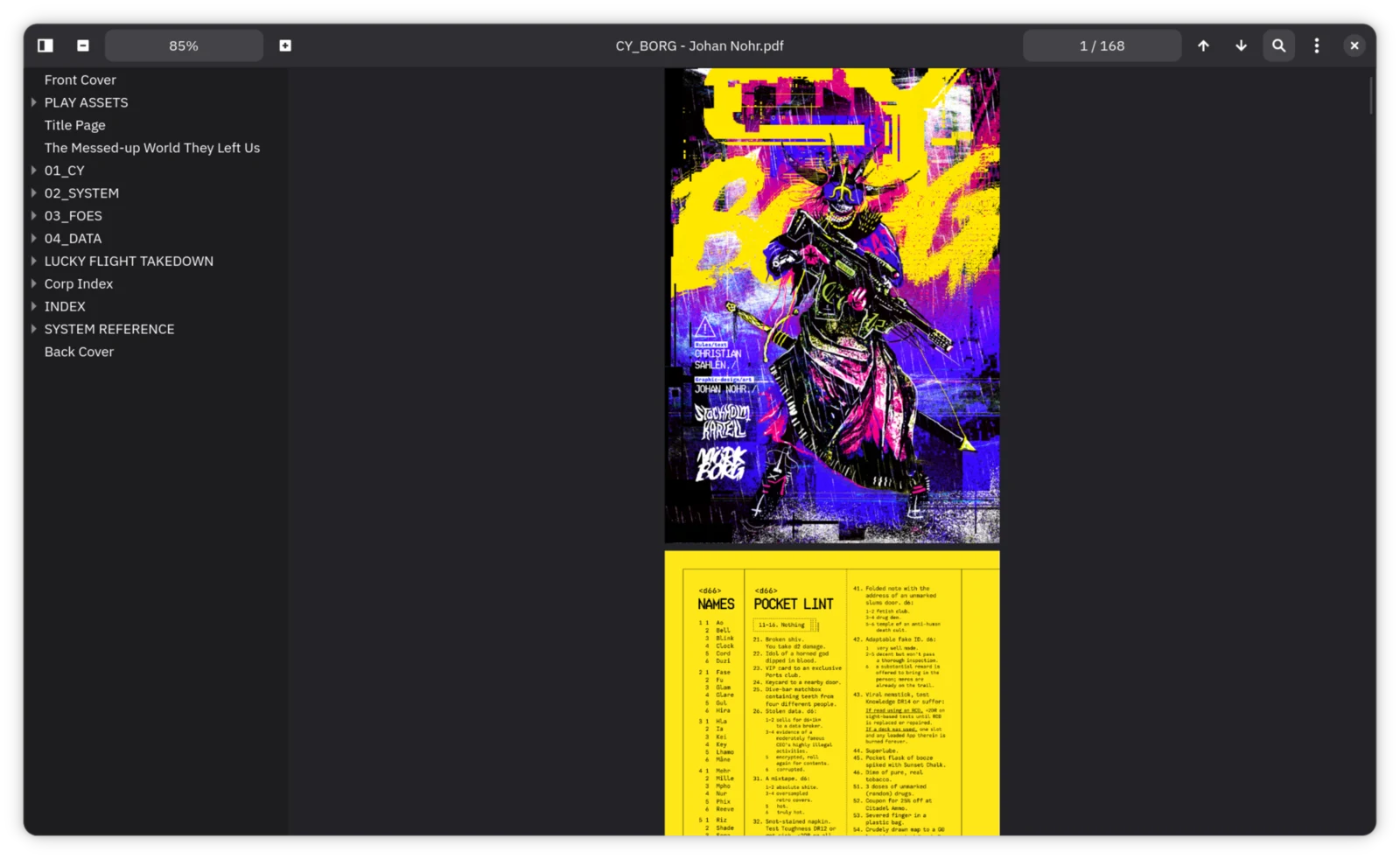
A native GNOME document viewer for PDF, DjVu, CBZ, CB7, CBT, CBR, XPS, EPUB, FB2, MOBI, AZW3, and Markdown: the gap between feature-heavy clients (Okular) and bare MuPDF wrappers, a SumatraPDF-shaped experience for Linux. A three-tier cache (persistent thumbnails, parsed page handles, rendered Cairo surfaces) with bytes-aware eviction, parallel rendering across eight independent MuPDF instances, and a zero-copy MuPDF→Cairo pipeline that builds the pixmap around the Cairo surface buffer.
A velocity engine throttles render dispatch by scroll speed so fast-scrolling never queues stale work, a thread-pool sort keeps the viewport ahead of the queue, and mid-render fz_cookie abort lets workers bail in milliseconds. Manga (RTL), Webtoon, and facing-pages comic layouts, all live-toggleable, with aspect-ratio and filename-based double-spread detection for scanlation rips. Async progressive search over cached structured text (332 ms cold → 48 ms warm on a 901-page textbook), reading-order-aware text selection, a magnifying loupe (F7), and GFileMonitor auto-reload that refreshes a recompiled LaTeX or Typst doc with scroll position preserved.
The ebook formats reflow natively through an embedded WebKitGTK view: each backend parses its format (an OPF spine walker for EPUB, a MOBI / KF7 / KF8 / AZW3 parser with HuffDic decompression ported from foliate-js, vendored md4c for Markdown) and emits one stitched HTML document, with images served over an internal framework-img:// scheme and typography and reading themes pushed in live as CSS custom properties. A process-scoped Linux Landlock LSM sandbox drops filesystem EXECUTE and MAKE_* rights at startup, so a malicious document exploiting MuPDF / DjVuLibre / libarchive into RCE cannot escalate to a shell. Strictly a viewer: no annotations, no library, no conversion. Every borrowed pattern (SumatraPDF, zathura, Sioyek, YACReader, Foliate, MComix, Komikku, Plato) is attributed in the README with upstream file:line. A Flatpak manifest ships alongside the native build.
CalibreQuarry
A CLI toolkit for power users of Calibre. Zero external dependencies: sqlite3, argparse, curses, and nothing else. Its hand-written recursive-descent parser hits 100% parity with Calibre’s internal search-expression syntax, validated by a test suite mapped against Calibre’s own SearchQueryParser. The same engine resolves Virtual Library definitions out of the preferences table and powers the --search mode (author / vl: / boolean / parens / =-prefix exact match).
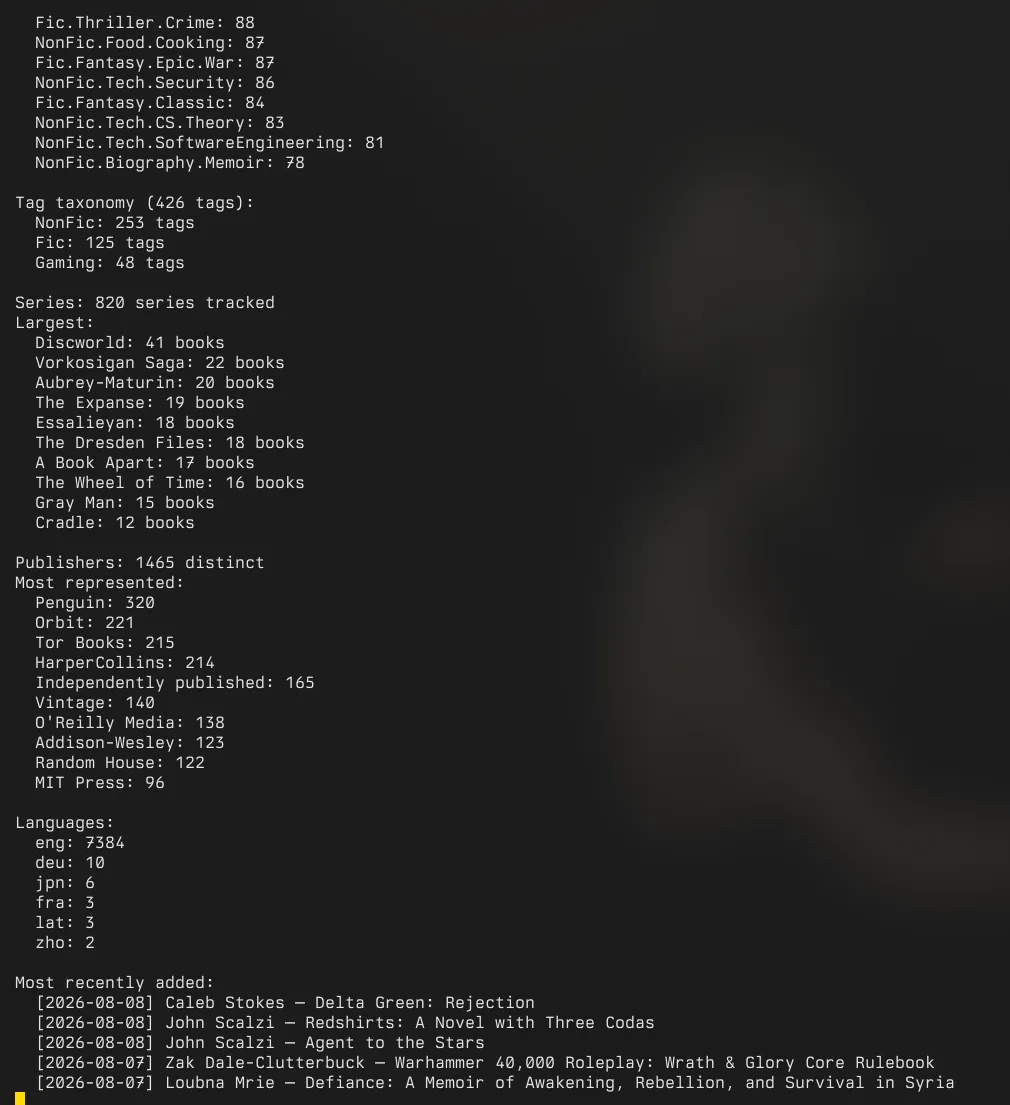
Author-grouped catalogs, with --all-wings emitting one per virtual library. Library statistics across format, rating, tag taxonomy, and top authors / tags. Audit modes for untagged, unrated, coverless, series-gap, duplicate, and low-resolution covers (parsing on-disk JPEGs with no external libraries); analytics modes for per-author breakdowns, added-per-month pace, hierarchical tag trees, and wing overlap. JSON / CSV / AI exports, custom-column extraction, and an automatic DB snapshot when Calibre holds a write lock. Installs as cquarry. Complete software, tested on Fedora 44 against Calibre 9.7.
deadbeef-cui
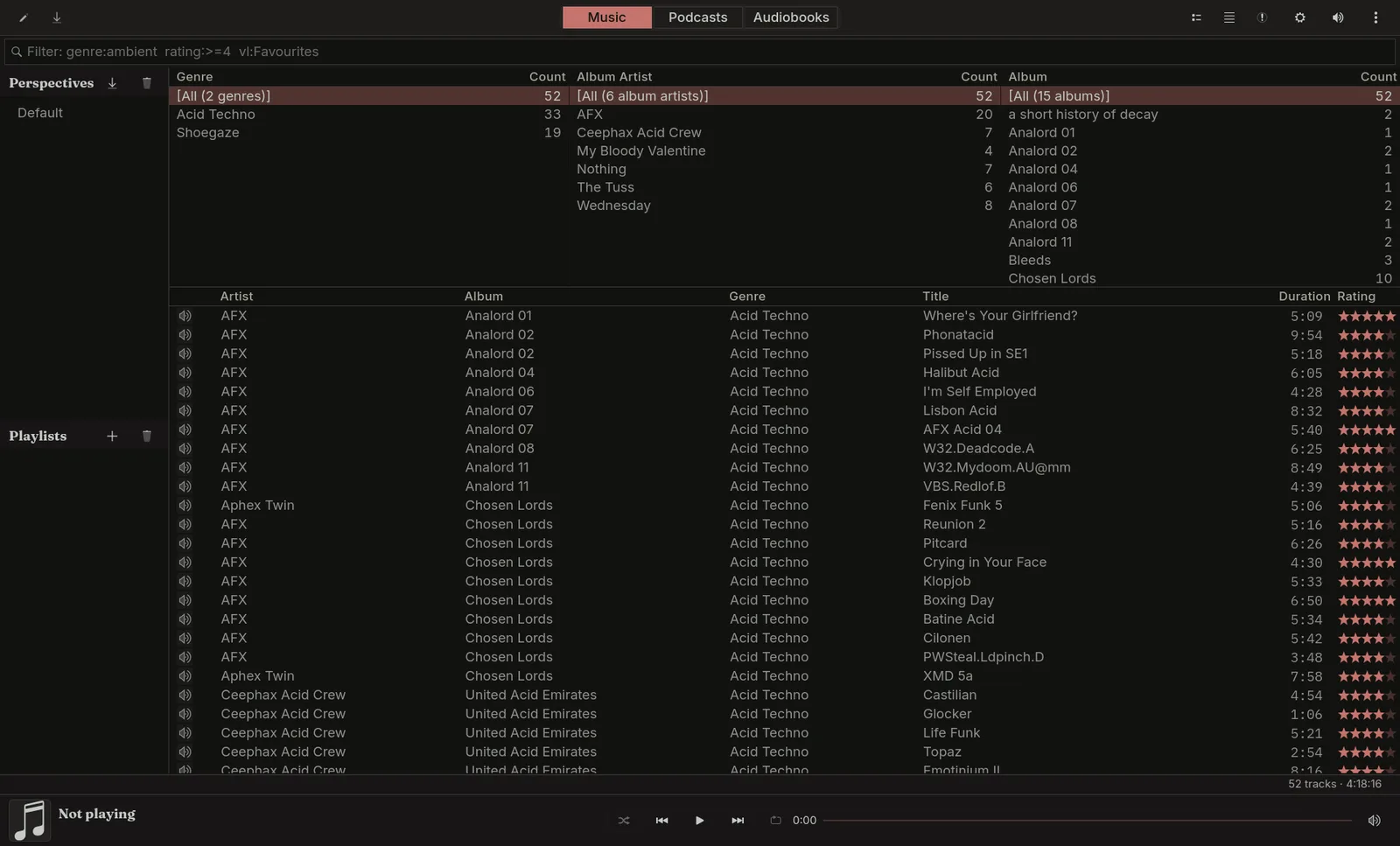
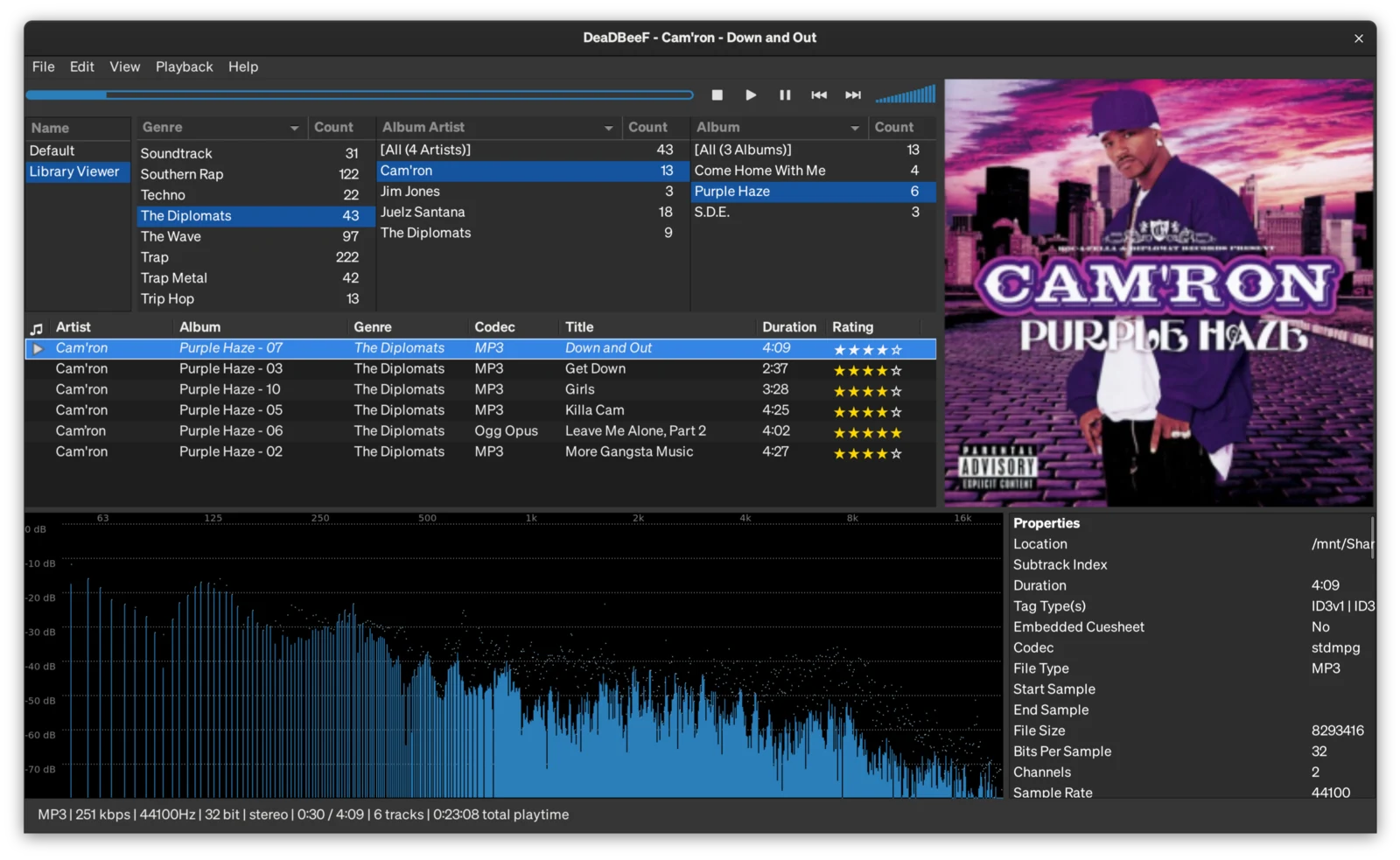
A faceted-browser plugin for the DeaDBeeF music player, bringing foobar2000-style Columns UI / Facets to Linux. 1–5 dynamic filter columns with hierarchical narrowing, full title-formatting support, multi-select aggregation across genres and artists via Ctrl/Shift-click, an in-pane search bar (Ctrl+Shift+F), and a settings dialog with per-instance configuration so multiple Facet Browsers can coexist in one layout.
The standard DeaDBeeF track context menu is wired in (Play Next / Play Later / Properties / Convert / Reload metadata alongside the facet-specific items), tracks drag out of facet rows onto playlist tabs via the same DDB_PLAYITEM_POINTERLIST payload the GTKUI medialib widget uses, and “Send to new playlist <row name>” names the destination after the right-clicked tag. Everything targets a dedicated “Library Viewer” playlist so the plugin never touches curated playlists. Built natively against DB_mediasource_t, with an in-tree GTest suite driving the real engine against a mocked DeaDBeeF API, clean under ASan/UBSan. Complete; fixes only from here.
Belfry
A native GNOME 50 podcast client: Overcast’s audio engine and Castro’s triage model on a filesystem you can ls. Smart Speed and Voice Boost are ffmpeg filter chains (silenceremove, acompressor, loudnorm, rubberband) calibrated against Overcast; the Castro Inbox → Queue → Played flow is the daily metaphor. The library is filesystem-canonical, so a user with find and mpv can play their shows without Belfry running, and deleting the database triggers a rescan rather than data loss.
The same single-writer SQLite worker that Viaduct and Atrium use feeds four concurrent producers here. A four-crate workspace, with Calibre’s library-as-database UX (filter grammar, sortable columns, bulk actions, saved Perspectives, Wings-style collections) layered over the triage states, and per-show overrides so a four-hour history episode and a twenty-five-minute tech show keep independent playback rules. GPL-3, forced by librubberband. Phase 1 landed the SQLite worker, read pool, and fixtures; no UI yet. Slated for absorption into Conservatory, whose podcast subsystem retires Belfry at parity.
Conservatory
A native GNOME library manager that owns and organizes your music, podcasts, and audiobooks on disk, presented through a foobar2000 Columns UI browse surface and played through a libmpv daily-driver engine that runs all three media types from one queue. Designed as Calibre for audio.
It absorbs the Belfry podcast client, converging that engine and triage model with a massive faceted music browser. The database is truth; the on-disk tree is a rendered template; moving an album re-renders the filesystem. A Calibre-shaped search expression language, multi-select bulk actions, and embedded-tag write-back so files stay portable. The headless manager already imports, resolves, and crash-safely moves files on disk with a full undo journal, and the first GTK Columns UI browse window has landed. Phases 1 through 3 are in, building concurrently with Atrium under hard phasing; Belfry retires only at podcast parity (Phase 6).
project-void
A design-stage CRPG and the data-driven engine that ships under it. The engineering commitment is the engine: rules expressed as universal TOML/Lua state machines, decoupled from the renderer, so the same binary could host Cairn, 5e, or any other system with a sheet and a turn order. The campaign is the demonstration. The Reach is a tight 15–20-hour run through a region of city-states, free companies, counting houses, an inquisition, and a ruined library-city.
Lethal Cairn-derived combat math: attacks hit automatically, HP is low, damage drains into real wounds via attribute damage. Combat as a positional puzzle, not a dice minigame.
private, in development
project-yeschef
YES CHEF (working title): a single-player, character-driven grand-strategy restaurant simulation in the lineage of Crusader Kings 3 and Victoria 3, pointed at the most volatile small business there is. You play the General Manager. You do not cook. You hire, fire, schedule, invest, negotiate, and hold the room together while the restaurant tries to kill itself around you. People are the system: every mechanic flows through characters with stats, traits, opinions, and agendas, and the food is what comes out of the humans who make it.
There is no win condition. The player declares an ambition (Michelin star, neighborhood institution, empire, or simply survival) and the simulation generates the matching challenge. Each new game procedurally generates a city with its own demographics, regulatory climate, and competitive landscape, where rival restaurants each run their own GM, poaching staff, collapsing, and retaliating. Data-driven on Godot 4 with Lua, Ink, and TOML, so event packs, trait packs, and city templates ship as drop-in content for modders. The former chef’s project. Pre-development: skeleton and design docs, no engine code yet.
private, in development
opends
An open community toolkit and bugfix-patch project for SSI’s Dark Sun CRPGs, Shattered Lands (1993) and Wake of the Ravager (1994). Tools first, patches second: a GFF container reader/writer, a GPL bytecode disassembler and byte-exact reassembler, a dialog extractor, a save inspector, and a region renderer, each a standalone MIT-licensed tool with its own README and version. Twelve ship today, working and tested (142 passing tests across a six-crate Rust workspace, with stdlib-Python companions). Nothing here redistributes a byte of the game: you bring your own GOG copy, and the toolkit reads and patches it through an overlay mount that never touches the original install. The darkfix patches the tools exist to produce are the next milestone, not yet shipped.
The hard problem is the engine’s embedded scripting language, a GPL bytecode VM with no public spec; two decades of full-reimplementation attempts have all stalled there. OpenDS goes at it sideways, shipping the artifacts built on the way to an engine (disassemblers, chunk editors, format docs) as standalone tools, each useful on its own. The disassembler carries the full 129-entry opcode catalogue, and the reassembler round-trips the games’ bytecode chunks byte-for-byte. It stands on the deepest prior reverse-engineering work (paulofthewest and the dsoageofheroes org for the GFF layout and that opcode catalogue) and keeps a per-feature manifest mapping each tool to the upstream file it came from.
kanagawa-dragon-nvim-emacs
A faithful Emacs port of the Dragon variant from kanagawa.nvim. Not a repackaging of the existing kanagawa-themes package; that one has the palette right but covers too few faces to hold up in practice. This one maps the full set: every Emacs 29+ tree-sitter font-lock-* face, all Doom-specific surfaces (doom-modeline-*, solaire-mode, doom-dashboard-*), org-mode faces, magit, company, corfu, and the rest of the usual zoo. Implemented as a vanilla deftheme with no doom-themes macro dependency, so it works in stock Emacs and in Doom alike.
An ERT test suite checks palette byte-for-byte parity against the upstream nvim theme and validates representative face attributes. The acceptance criterion is visual: sample.java in Doom at treesit-font-lock-level 4 should match the same file in nvim with :colorscheme kanagawa-dragon.
not yet public
Bindery
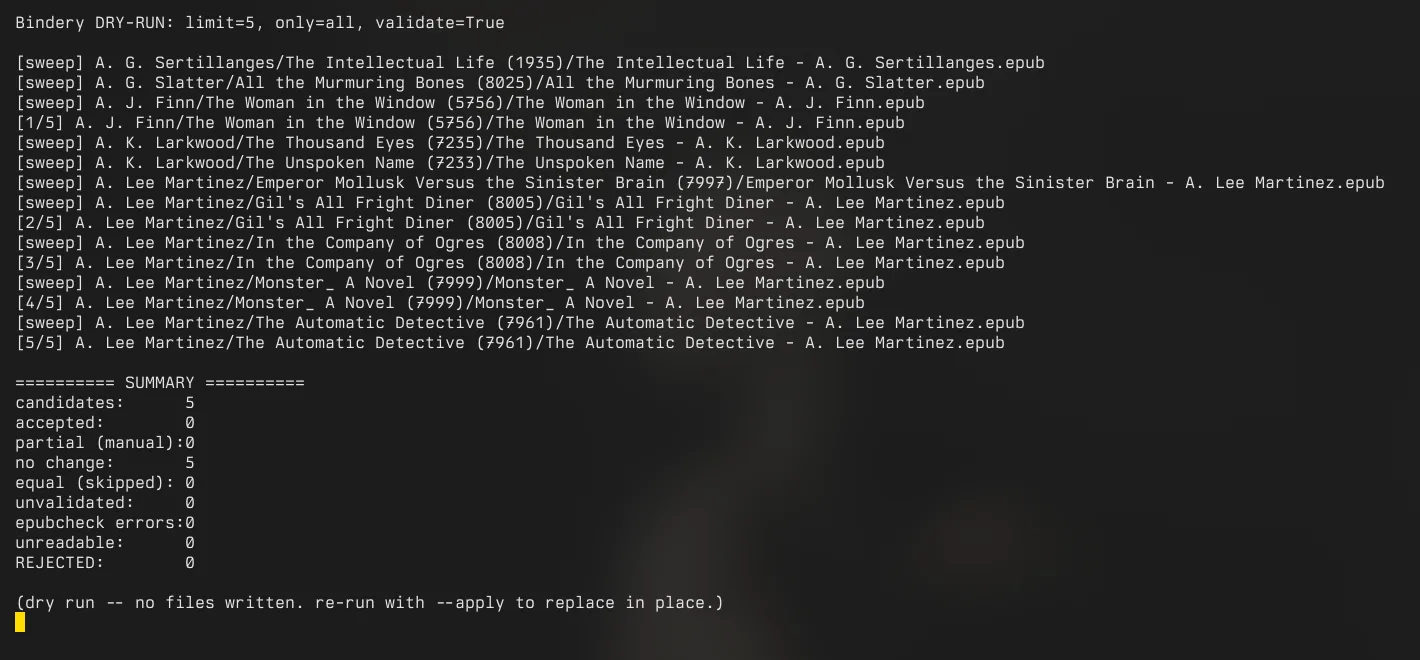
A command-line surgeon for malformed EPUBs. The fixes are deliberately boring: self-close the void elements, convert named entities to numeric, sync the NCX uid with the OPF, put the mimetype entry first in the zip. Each one is deterministic, and each one lands only if epubcheck confirms the patient actually improved. epubcheck stays an external oracle, never a Python dependency; the package itself is stdlib only. Dry-run is the default mode, and --apply backs up before it touches anything.
Built to operate inside a Calibre library without breaking it: a repair atomically replaces only the .epub, leaving metadata.opf, cover.jpg, and the database for Calibre’s own Quality Check to re-sync. Sibling to oceanstrip; the two share the epubcheck no-regression gate.
oceanstrip
Strips OceanofPDF.com watermarks out of EPUBs. The removal is balanced-element surgery rather than regex slicing: locate the injected markup, remove whole well-formed elements, leave the surrounding document untouched. Works on a single file or sweeps an entire library, always writing new copies (originals are never modified), and every output is epubcheck-clean. Stdlib only, like its sibling Bindery.
AudiobookTools
A declarative tag-and-folder normalizer for an audiobook shelf. One catalogue file is the source of truth: retag writes the embedded metadata from it, reorg renders the on-disk folder tree from it, and the files and the shelf cannot drift apart because both are projections of the same data. The engine is generic and the catalogue is data; the two never mix.
The operational contract does the heavy lifting. Dry-run is the default for everything; every --apply writes a manifest that fully reverses it; a second dry-run after an apply must report zero changes. The tests enforce all three properties, which is what lets a bulk retag of irreplaceable audio feel routine instead of reckless.
⁂
III. Marginalia
Off-screen taste. Most of the projects above trace back to one collection or another.
- Reading
- 10–20 books a year. Grimdark fantasy, cyberpunk, horror. Authors I return to: Joe Abercrombie, Brandon Sanderson, Morgan Housel, Terry Pratchett. Shelf at Goodreads.
- Collecting
- TTRPGs. The Calibre library runs deep here: OSR (Old School Essentials, Carcosa, Mothership), Forged in the Dark (Blades in the Dark and its extended family), World of Darkness, Shadowrun, the classic AD&D and Dark Sun lines. Drawn less to the play and more to the engineering: games that keep real ideas behind their front pages.
- Music
- Hip-hop, emo, orgcore. The collection runs into four figures across 86 genre wings: abstract rap (Aesop Rock, Armand Hammer, Earl Sweatshirt), hardcore hip-hop (the Griselda family, Ka, Billy Woods), emo and post-hardcore (Brand New, The Menzingers, Self Defense Family, Drug Church), orgcore (Jeff Rosenstock, Propagandhi, Jawbreaker). Neoclassical at the edges where the math works the same way: Ólafur Arnalds, Nils Frahm, Ryuichi Sakamoto. Scrobbles at Last.fm.
- Food
- Chefs I follow (and one place I sat down at): David Chang; David McMillan & Frédéric Morin at Joe Beef (ate there myself, a high point); Danny Bowien (Mission Chinese); Daniel Patterson (Coi).
- Tools
- Fedora 44 on a ThinkPad T14s. Ghostty + zsh + starship. Neovim and Doom Emacs.
eza,bat,zoxide,fzf. IBM Plex Mono in the terminal; Source Serif 4 here.
❦
IV. Writing
A working notebook. Notes, post-mortems, the occasional manifesto, and once in a while a What I Use.
- 2026 · 05 · 16 The Workshop: A Day at the Terminal
- 2026 · 05 · 12 What I Use: Constraints and Good Iron
❦
V. Support
The projects live at github.com/VirInvictus. On Mastodon at @Bdkl@mastodon.social. Professional profile at linkedin.com/in/bdkl.
If any of this is useful to you and you’d like to chip in:
bc1qkge6zr45tzqfwfmvma2ylumt6mg7wlwmhr05yv