From the collection
CalibreQuarry
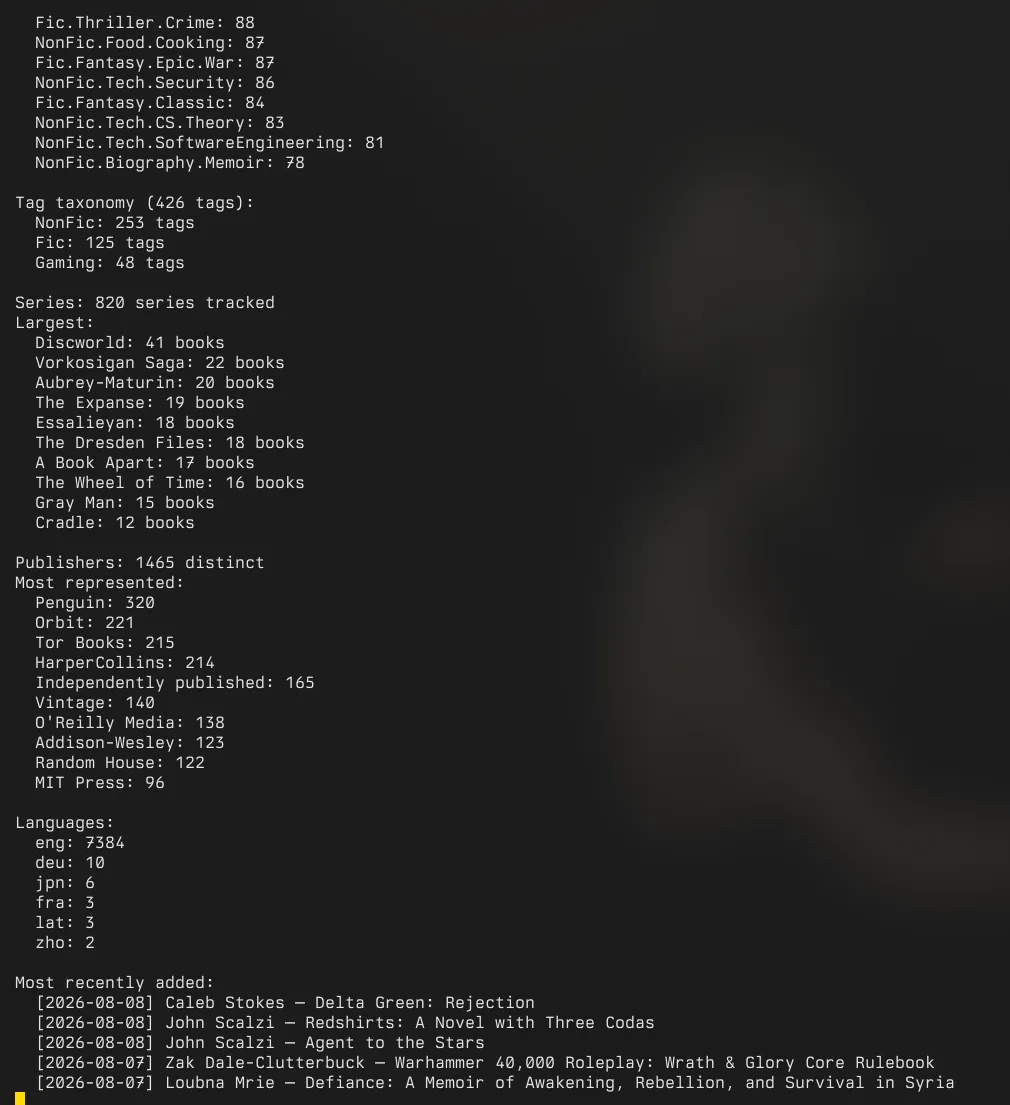
Calibre power-user tooling built on cquarry, the same core powering Hermitage and bindery-cli. Its recursive-descent parser hits 100% parity with Calibre’s internal search-expression syntax, validated by a test suite mapped against Calibre’s own SearchQueryParser. The same engine resolves Virtual Library definitions out of the preferences table and powers the --search mode (author / vl: / boolean / parens / =-prefix exact match).
Author-grouped catalogs, with --all-wings emitting one per virtual library. Library statistics across format, rating, tag taxonomy, and top authors / tags. Audit modes for untagged, unrated, coverless, series-gap, duplicate, and low-resolution covers (parsing on-disk JPEGs with no external libraries); analytics modes for per-author breakdowns, added-per-month pace, hierarchical tag trees, and wing overlap. JSON / CSV / AI exports, custom-column extraction, and an automatic DB snapshot when Calibre holds a write lock. Installs from PyPI as calibrequarry. Tested on Fedora 44 against Calibre 9.7.
Alongside the package sits a scripts/ shelf of write-capable companions, deliberately outside the read-only contract: audit_drm.py scans every format for encryption a metadata sweep would wave through, reconcile_file_metadata.py compares curated database values against the metadata embedded in each file (and can push the database back into the files), validate_metadata.py lints the metadata.db itself, spot_check.py samples random books for the corruption pattern sweeps miss, and compress_pdf.py shrinks the occasional 1 GB sourcebook through ghostscript.
The newest of them, audit_isbns.py, asks a question nothing else in the Calibre ecosystem does: not is this ISBN well-formed but does it identify this book. Calibre downloads metadata and never re-examines what it stored, so a wrong identifier stays invisible behind a passing checksum. A four-source sweep of a validator-clean 6,786-ISBN library found 51 pointing at a different book, the dominant shape being a same-publisher sibling; Programming Clojure carried tmux 2’s number, and A Book on C carried 9782147483649, the 2147483649 integer-overflow constant dressed as an ISBN. The script verifies against the ISBN each book prints on its own copyright page, reading body text only and never the embedded metadata, because reconcile_file_metadata.py writes the database’s values into those blocks and comparing against them would confirm every error the tool exists to find. Most of the work is not crying wolf: a bibliography printing 49 other ISBNs is classified as a citing work, a bundle reports AMBIGUOUS for a human, and a print-versus-ebook variant sharing the registrant prefix reports VARIANT rather than SUSPECT. There is deliberately no --apply and there will not be one, because single-source verdicts proved wrong often enough that an auto-fixer would have “corrected” four books that were already right.