From the collection
lattice-music
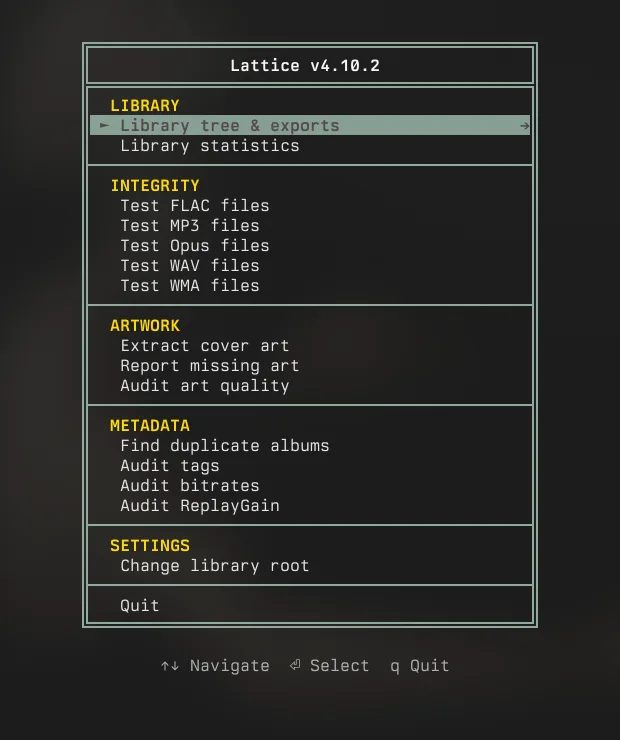
Tooling for music collectors who keep the filesystem as the source of truth. Library-tree visualization across artist / album / track / rating / genre. Parallel FLAC / MP3 / Opus / WAV / WMA integrity verification (shelling out to flac -t and ffmpeg), embedded cover-art extraction with format-priority ranking, an art-quality audit against a configurable resolution floor, and tag, bitrate, and duplicate audits. Smart .m3u generation from dynamic rules (rating >= 4 and genre == 'Jazz'), per-genre wings (one library file per genre, like Calibre virtual libraries for music), and a token-efficient --ai-library export sized to fit a 4,000-album collection inside an LLM context window. The directory layout is configurable, so the tools never fight you about your shelving. Bare lattice opens a full-screen TUI powered by vir-tui.
The package is read-only by default: it reads tags, decodes audio, writes reports. Writing is opt-in through two explicit write modes, --clean and --apestrip (dry-run unless --apply is passed), whose brains the v5.0.0 fold moved into the package as lattice.norm with modes/clean.py / modes/apestrip.py; the seven destructive companions remain in scripts/ as launchers over the same code: genre_tidy.py applies a genre policy map library-wide, rerate.py reconciles MP3 POPM rating bytes with DeaDBeeF and foobar, genre_foldermap.py restructures the tree into Genre / Artist / Album, replaygain.py writes ReplayGain 2.0 tags through rsgain, and apestrip.py removes stray APEv2 tags. Two are worth spelling out. retag.py is the universal genre rewriter, abstracting the ID3 / Vorbis / iTunes-atom multi-genre chaos for safe bulk retagging. cleaner.py consolidates fragmented album folders: it finds sibling directories whose names normalize to the same key (curly→straight quotes, dash variants→ASCII hyphen, NFKC, lowercase) and merges them via shutil.move, touching no audio bytes. Size-differing collisions keep both copies under a .from-fragment suffix; --dry-run previews every move and the operation is idempotent on re-run.