From the collection
Quire
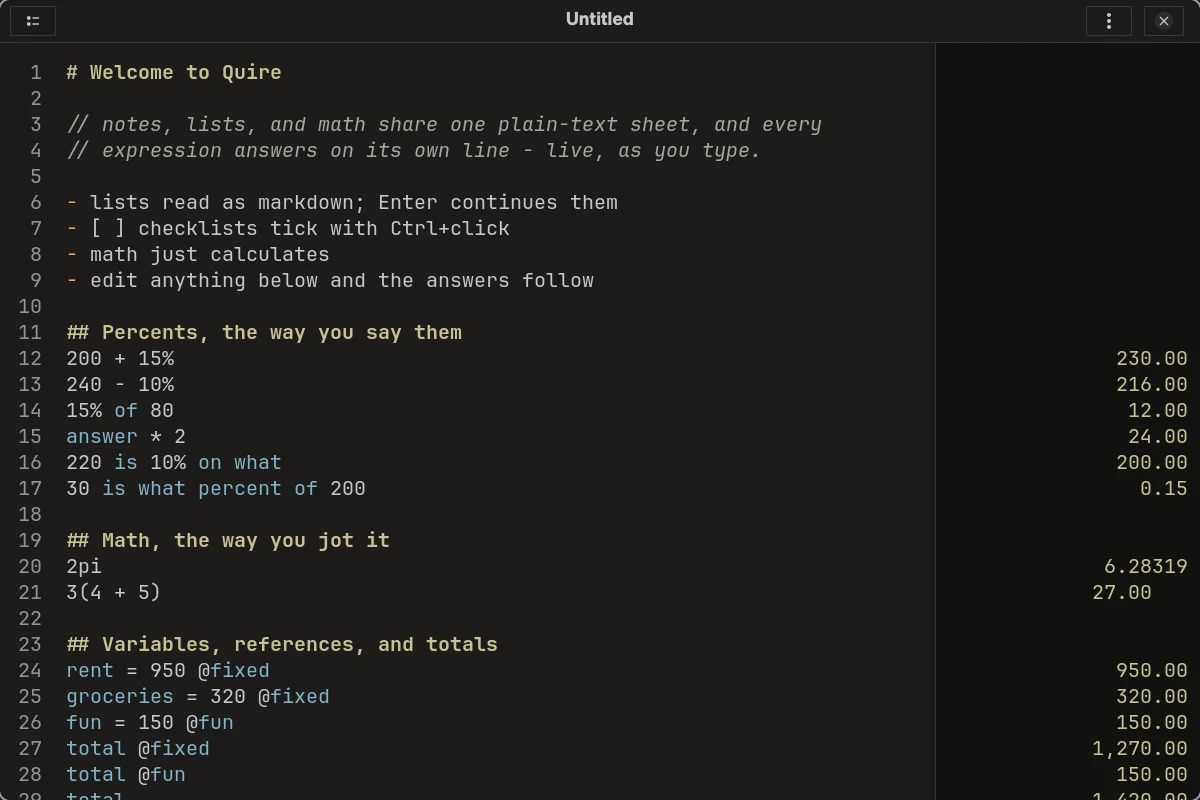
A Soulver-style notepad calculator for Linux: prose and math share one plain-text sheet, and every expression answers on its own line in a results column down the right edge. The sheet is the file. There is no project format underneath and nothing to save; the thing on screen is the thing on disk.
The evaluator is written for the way people actually scribble. Variables and bare references (groceries on its own line answers with its value), percentage forms that match how they are spoken (200 + 15% is 230, 15% of 200 is 30) including the reverse questions (220 is 10% on what), mixed lines where the words strip away and the math is left (50 apples at 3 each is 150). Since 1.2, sentences with quantities answer too (the stock solution measures 2 mol/L answers 2 molar). Functions compose with recursion and literal-pattern clauses (fact(0) = 1, fact(n) = n * fact(n - 1)), and line references resolve in both directions: a summary line at the top of a sheet can cite the derivation at the bottom, and the sheet re-evaluates until every reference settles. Tags group lines into sheet-wide views, checkboxes tick with Ctrl+click, and the caret’s line carries a subtle band. Units ride an embedded numbat engine with dimension checks (5 kg + 300 g), and currency runs on an ECB reference-rate snapshot cached under ~/.cache/quire, so conversions work offline forever after the first fetch. An error belongs to its line: the exact token that failed underlines in place, and no other line ever breaks.
The menu ships worked templates (a mortgage walkthrough whose summary cites its own derivation, a freelance invoice with discount and VAT, a budget with variance, a portfolio, a trip planner, a scientist’s lab notebook), and quire-cli turns any sheet into its answers column as text or JSON for terminals and agents.
Two crates: quire-eval, the UI-free engine, behind quire, a plain GTK4 app with no libadwaita, styled by vir-gtk like the rest of the collection.